I. INTRODUCTION
In the context of the rapidly developing global and Vietnamese economies, questions about the meaning and purpose of economic development have become more important than ever. Is GDP growth sufficient to measure a nation’s prosperity? How can we ensure that economic benefits are distributed fairly? What is the role of human beings in emerging economic models? And what constitutes an economy that truly serves people?
Current economic, social, and environmental challenges—from income inequality and climate change to changes in labor relations driven by digital transformation and artificial intelligence—require us to reconsider the nature of the economy. The world is witnessing three major transformative trends reshaping how we organize and operate economic systems:
First, the ESG (Environmental, Social, and Governance) movement is evolving from a recommendation to a requirement for businesses. Global investors increasingly focus on transparency regarding companies’ environmental impact, social responsibility, and governance practices. In Vietnam, regulations on sustainable business practices and ESG criteria are being developed, requiring enterprises not only to report business performance but also to disclose their social and environmental impacts. This raises a fundamental question: how can businesses achieve economic efficiency while positively contributing to society and protecting the environment?
Second, the green economy and circular economy are emerging as key trends in responding to climate change. Vietnam has set sustainable development goals, promoting the transition from linear to circular production models. However, this green transition poses numerous challenges, especially for small and medium enterprises, workers in traditional industries, and vulnerable communities. How can this transition be managed harmoniously, creating opportunities for all stakeholders?
Third, the digital economy is restructuring every aspect of economic life—from production and distribution to consumption. Digital transformation, artificial intelligence, and digital platforms create new opportunities but also bring new challenges. In Vietnam, digital transformation is being vigorously pursued with the goal of developing a digital economy. However, disparities in technology access across regions, demographic groups, and generations require attention. Workers in platform-based economies often need additional protections. The question arises: how can the digital economy serve as a tool for opportunity for everyone?
These three transformative trends, together with challenges such as income inequality, food security, and public health, are driving interest in new economic models: circular economy, sharing economy, care economy, social economy, and human-centered economy. In these models, humans are not merely a production resource or consumers but the center and purpose of all economic activities.
Human-centered economics, or people-oriented economics, places human dignity, social welfare, and sustainable development at its core. This is not only an academic theory but also a practical approach being pioneered by numerous countries and organizations. Models such as New Zealand’s Wellbeing Budget, Bhutan’s Gross National Happiness (GNH) index, social enterprises, and purpose-driven businesses worldwide exemplify the vitality of this philosophy.
In Vietnam, as the country pursues long-term socio-economic development goals, orienting economic development toward a human-centered approach is not only meaningful but also a strategy for sustainable development. Issues such as job quality for workers, protection of workers’ rights in global supply chains, reducing income gaps, ensuring social welfare amid green and digital transitions, and developing sustainable local economic models present challenges requiring innovative approaches. In particular, harmonizing the three ESG pillars with economic growth while balancing stakeholder interests during transitions is a critical task for policymakers, businesses, and the research community.
The Research Together Program provides a space for dialogue and mutual learning, initiated by the SocialLife Research Institute. Rather than a one-way relationship between mentor and learner, the program creates an environment where young researchers and experts explore, discuss, and co-create knowledge. In this space, each member is encouraged to share observations and experiences while listening to and engaging with others’ perspectives.
An example of this approach is the three-volume series Contemporary Vietnamese Social Life, awarded the “Good Book” prize in the research category in 2018. This work is not merely a collection of independent studies but the outcome of dialogue and collaboration across generations of researchers. Each chapter emerged from lively discussions, where ideas were exchanged, critiqued, and refined through contributions from both mentors and learners.
Over the past three years (2023–2025), through interaction and mutual learning in the program, many young researchers have developed and completed unique studies on the lives of vulnerable groups, aspects of digital society, and changes in contemporary social structures. Building on this success, the Research Together 2026: Towards a Human-Centered Economy program seeks to continue cultivating an academic community where knowledge emerges from interaction and dialogue, aiming to develop economic, social, and environmental solutions with humans at the center.
Research Focus for 2026
SocialLife approaches research topics with a distinctive method: tightly integrating theoretical frameworks with real-life human experiences, particularly of vulnerable groups. We believe that all economic questions, regardless of theoretical analysis, must ultimately be situated within the context of concrete human life. Each research topic begins with the question: “How does this affect people’s daily lives, especially the most vulnerable in society?”
The 2026 program will focus on four major research pillars, reflecting SocialLife’s approach to studying human-centered economics from the perspective of vulnerable populations.
Pillar 1: Livelihoods and the Meaning of Work in Economic Fluctuations
This pillar explores how vulnerable groups build, sustain, and redefine livelihoods amidst contemporary economic changes. From informal workers and global supply chain laborers to care workers, the program examines how they define “good work,” “dignity,” and “fairness” in daily life. Studies focus on informal workers’ livelihood realities, the significance of care work, platform economy labor experiences, and the redefinition of “work” and “skills” amid automation and AI. Attention is also given to how workers create new forms of organization, negotiate rights in new labor spaces, and maintain boundaries between work and life.
Pillar 2: Green Transition, ESG, and the Environment
This pillar investigates how vulnerable groups and communities experience, interpret, and negotiate green transitions, ESG requirements, and sustainable practices. Beyond policy evaluation, the focus is on understanding how people perceive concepts like “green transition,” “social responsibility,” and “sustainability,” and how they adapt to these changes. Studies include corporate and worker interpretations of ESG practices within Vietnamese cultural contexts, consumer awareness and green consumption practices, local community understanding of sustainable energy, and circular practices in Vietnamese production and consumption.
Pillar 3: Digital Technology, Data, and Social Inclusion
This pillar examines how vulnerable populations interpret, negotiate, and adapt to digital technologies in daily life. Beyond studying the “digital divide,” research focuses on learning processes, the meaning of technology, and strategies people use to leverage or cope with digital transformation. Research directions include vulnerable populations’ engagement with digital financial systems, understanding and negotiating labor relations on digital platforms, learning and redefining “business” in the digital era, and ethical standards negotiation among stakeholders.
Pillar 4: Social Economy, Community, and Indigenous Knowledge
This pillar centers on diverse economic organizations, indigenous knowledge, and the role of community in economic development. It examines how communities create, maintain, and redefine economic values, forms of cooperation, and livelihood practices suitable for local contexts. Studies explore how minority communities construct livelihoods in changing environments, how local communities preserve and redefine indigenous economic values, the meaning of “care” and “labor” in paid care relations, and how social enterprises negotiate and construct notions of “success” and “impact.”
We encourage research to go beyond economic model analysis and delve into lived human experiences: How do informal workers face digital transformation? How do farmers adapt to climate change? How do migrant women balance work and family care? These questions are central to our approach, emphasizing listening, understanding hardships, and learning directly from those involved, thereby producing meaningful, practical knowledge.
II. BENEFITS AND DEVELOPMENT OPPORTUNITIES
1. Professional Research Development
Participate in highly interactive training on social and economic research methods
Receive guidance and direct interaction with economists and sociologists throughout the research process
Access modern research tools and methods suitable for the Vietnamese context
Attend seminars on human-centered and social economics, and sustainable development by leading experts
2. Publication and Research Dissemination Opportunities
Receive support preparing manuscripts for publication in domestic and international journals
Opportunities to contribute chapters to SocialLife research publications
Participate in academic conferences and forums to present and discuss findings
Receive assistance in connecting with publishers, journals, and relevant organizations
3. Professional Networking
Join the community of young researchers at SocialLife Institute
Connect and collaborate with national and international experts and researchers
Participate in thematic Research Labs
Opportunities to engage in research or consulting projects of the Institute and partners post-program
4. Support and Official Recognition
Receive a certificate of completion from SocialLife Institute
Access to Institute facilities and research resources
Receive technical and professional support for data collection (if applicable)
Introduced to future research projects, job opportunities, and postgraduate scholarships
Note: Benefits are contingent on active participation and commitment throughout the program.
III. ELIGIBILITY AND PARTICIPATION CRITERIA
1. Eligible Participants
Final-year students or graduates in social sciences, humanities, economics, or related fields
Faculty members or young researchers at universities or research institutes
Staff working in non-profits, social enterprises, or cooperatives
Young professionals under 35 interested in social and economic research
2. Basic Requirements
Basic knowledge in social sciences (sociology, economics, anthropology, etc.)
Experience in small-scale research (theses, reports, or published articles)
Ability to read basic English materials in social sciences
Open-mindedness and willingness to engage in dialogue and learning
3. Commitment
Ability to participate in program activities for 12 months
Willingness to dedicate time for reading and independent research
Commitment to research ethics
Active contribution to group activities and professional discussions
4. Preferred Qualifications
Experience working directly with vulnerable groups, social enterprises, cooperatives, or local communities
Research proposals related to program priority topics
Demonstrated long-term commitment to research and social development
Ability to disseminate research results to communities and relevant organizations
Note: The program encourages diversity in participants, including underrepresented regions and practical experience in socio-economic fields.
IV. PROGRAM STRUCTURE
Phase 1: Research Idea Exploration (2 months)
Submit and select applications
Conduct workshops to share and discuss research ideas
Connect applicants with experts and refine preliminary proposals
Phase 2: Accompaniment and Development (6 months)
Interactive training in social and economic research methods
Seminars on human-centered economics, social economy, and sustainable development
Hands-on workshops and group discussions
Conduct field data collection with support from mentors
Regular consultations with guiding experts
Support in data processing and analysis
Continuous assessment and feedback on research progress
Skill-building in writing and presenting research results
Phase 3: Dissemination and Application (4 months)
Finalize research and prepare manuscripts for publication
Conduct presentations and peer reviews
Workshops to share findings with stakeholders
Connect with potential partners (organizations, businesses, NGOs) to apply research outcomes
Support in planning dissemination and follow-up activities
Note: Program structure may be adjusted to fit the needs and progress of each research group.
V. TRAINING AND ASSESSMENT PROCESS
1. Preparation and Initial Assessment
Provide core learning materials on social sciences and economics
Self-study and review over 1 month
Knowledge assessment via:
Multiple-choice tests on social sciences and economics fundamentals
Essays analyzing and proposing research directions
Group discussions assessing critical thinking and interaction skills
2. Intensive Training
Module 1: Research Skills Practice
Literature review, theoretical framework selection, analytical design
Research project management
Data management (collection, entry, cleaning, and software use: SPSS, R, Python)
Module 2: Research Specialization
Participate in SocialLife Research Labs
Contribute to ongoing projects
Engage with experts in Lab activities
Courses in research ethics, EDI principles, participatory research, and social science methodology
Module 3: Specialized Seminars
Present, discuss, and exchange ideas on specialized topics
Topics include human-centered economics, social enterprises, income inequality, labor in the digital economy, sustainability, and climate change
3. Evaluation and Feedback
Criteria:
Skills and attitude: 30% (participation, teamwork, initiative)
Expertise: 40% (tests, assignments, reports, application of theory)
Critical thinking: 30% (analysis, synthesis, creativity)
Continuous assessment with regular feedback
VI. APPLICATION DOCUMENTS AND PROCEDURE
1. Required Documents
CV (Vietnamese or English) highlighting education, research, relevant work experience, and publications
Motivation letter outlining interest in human-centered economics, program goals, research plan, and intended societal contributions
Research proposal form detailing topic, scope, context, objectives, methods, expected results, and applicability
2. Submission Method
Complete application form: https://forms.gle/qobjfHMspkxEWqPG9
3. Deadline and Selection Process
Deadline: 17:00, Saturday, March 15, 2026
Review period: 2–3 weeks after submission
Interview: selected candidates will be invited in person or online
Announcement of results: early April 2026
Program start: late April 2026
Important Notes:
Incomplete applications will not be considered
Candidates must ensure the accuracy of information
Only shortlisted candidates will be contacted
For inquiries, contact the provided email during office hours
VII. CONTACT INFORMATION
SocialLife Research Institute
Email: duannghiencuu@sociallife.vn
Website: www.sociallife.vn
Address: 71/62E Dien Bien Phu, Gia Dinh Ward, Ho Chi Minh City
Phone: 0832231775 (Mr. Huy)
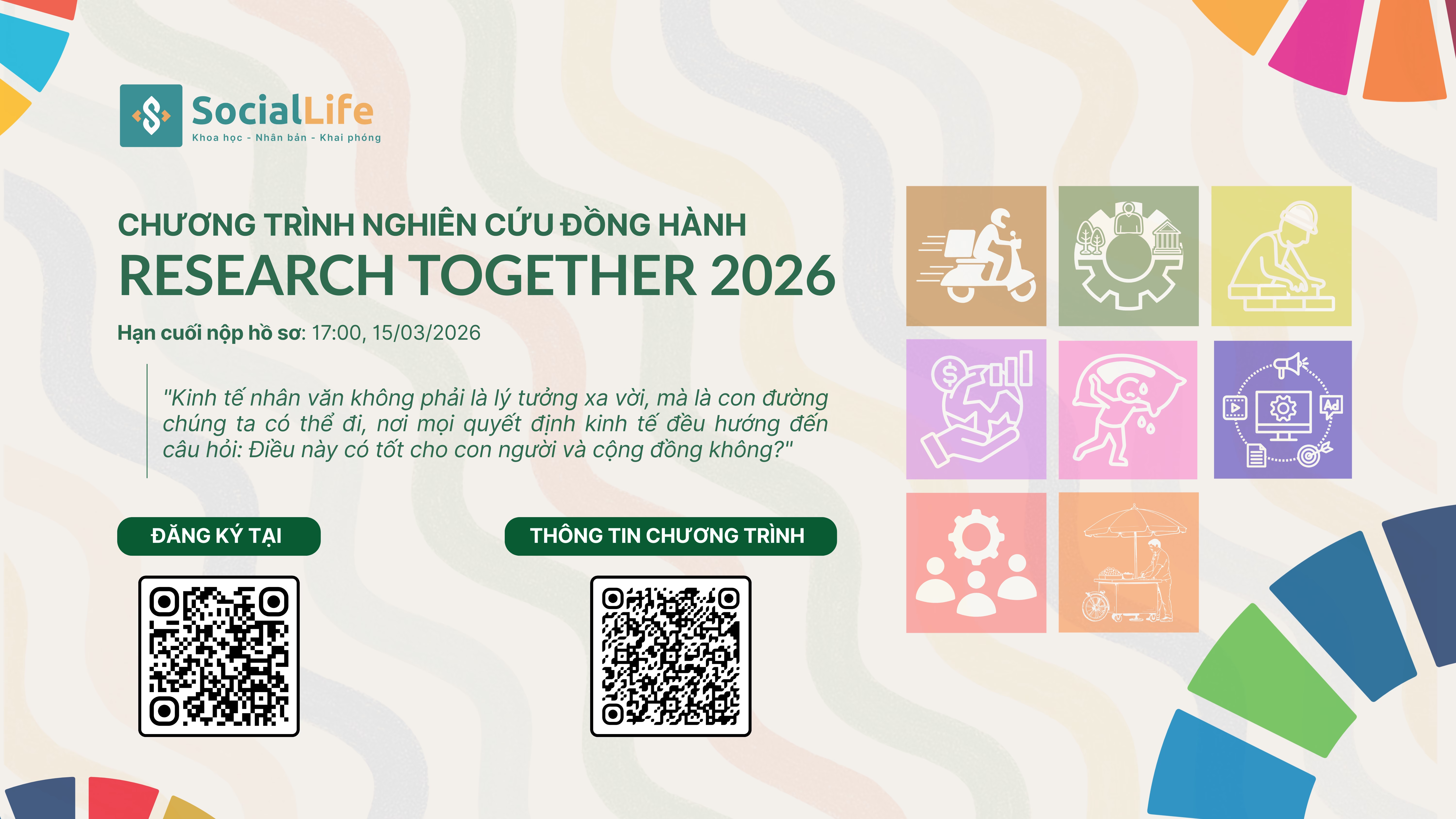
“Human-centered economics is not a distant ideal but a path we can follow, where every economic decision asks: Does this benefit people and the community?”
Join us in exploring and shaping an economy that puts people at its center!