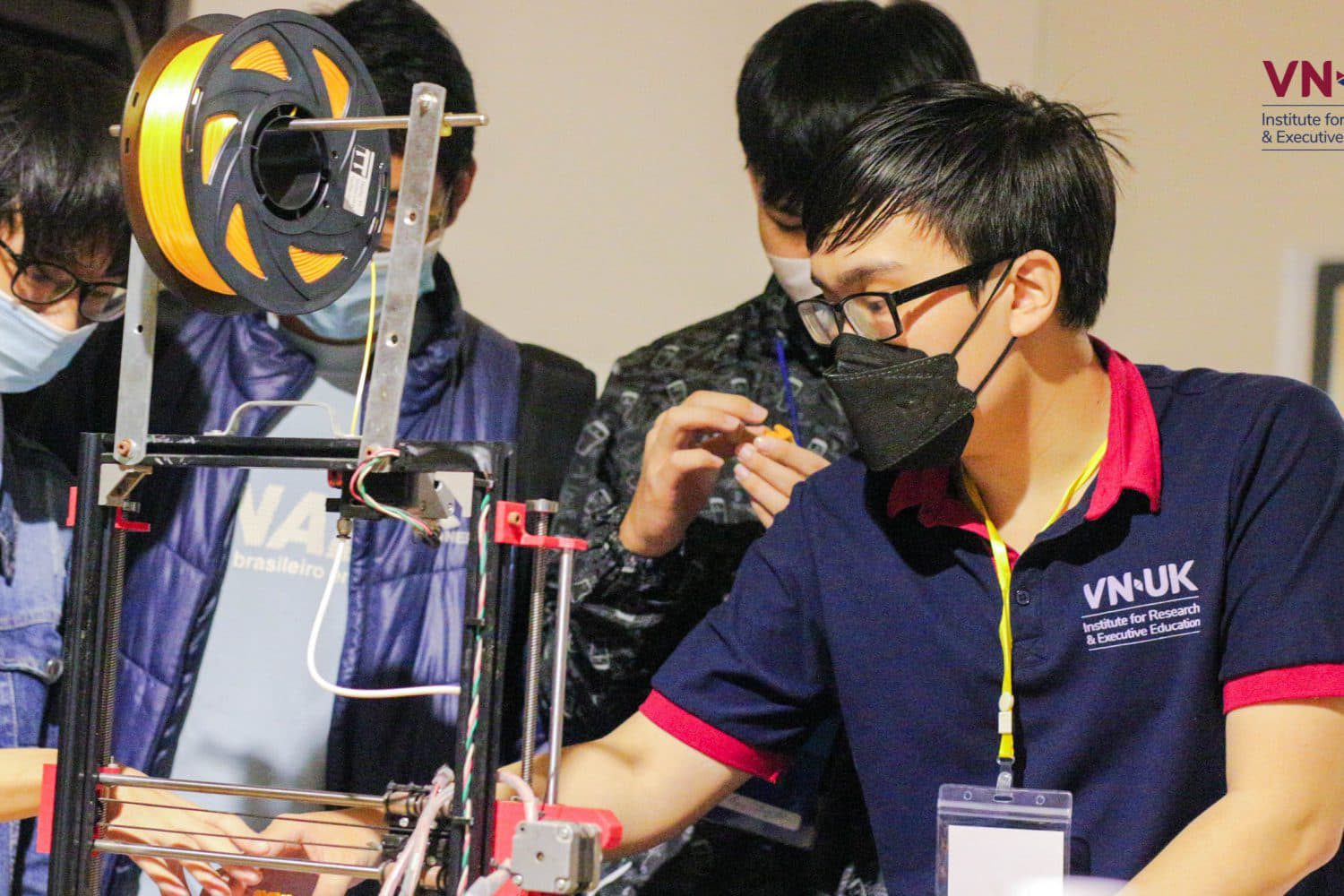
Applied Data Science – The Most Attractive Job of the 21st Century
Applied Data Science (ADS) is still a relatively new term in Vietnam in the era of Industry 4.0. However, it is gradually becoming a trend that businesses are adopting to boost their operations through insights gained from data-driven technologies. As the Fourth Industrial Revolution unfolds, all nations must increasingly rely on science, technology, and data. In this digital race, the winners are those who can master big data. This is also a field that has become a focal point attracting learners. Data scientists are emerging as one of the most sought-after professions. The Vietnam–UK Institute for Research and Executive Education is one of the pioneers in offering Data Science training in Central Vietnam.
The undergraduate program in Applied Data Science (ADS – VNUK), offered by the Vietnam–UK Institute for Research and Executive Education under the University of Danang, is supported and invested in by the Government of Vietnam to achieve international educational standards (aiming at AUN and ABET accreditation). The program’s mission is to train excellent students for both domestic and international labor markets, leading in undergraduate education quality, and equipping graduates with:
Professional readiness (through real work experience with industry partners via VNUK–industry joint projects, a six-month internship, and 25% of courses co-delivered by industry experts).
Academic readiness for higher studies (with high-quality teaching, course content, and quality assurance).
Lifelong learning capacity (cultivated during four years of study to foster the mindset of continuous improvement, guided by highly qualified lecturers).
Key Highlights of the Program:
Meeting the current high demand for Applied Data Science professionals, including Data for Life Sciences, Data for Socio-Economics, and Data for Technology.
Strong international connectivity through opportunities for exchange and transfer programs with top universities worldwide.
Development of practical working skills as students gain internship experience from the first year, engage in corporate internships, and complete a graduation project.
Development of transferable skills not only through internships but also via courses transferred from leading UK universities, such as academic skills, communication skills, and personal development planning.
Program Structure
Program Curriculum Structure 2025
No. | Knowledge Area | Credits |
1 | General Knowledge (General Education) | 41 |
2 | Fundamental Knowledge of the Major | 43 |
3 | Specialized Knowledge | 46 |
4 | Internship and Graduation Thesis | 20 |
| Total | 150 |
Training Program
First Year of University
- Academic English 1
- Academic English 2
- Academic English 3
- Communication Skills
- Academic Skills
- Applied Informatics (hoặc Computer Applications)
- English for Information Technology
- Global Culture
- Personal Development Planning
- Introduction to Programming and Computing
- Probability and Statistics
Second Year of University
- Object-Oriented Programming
- Systems Analysis and Database Design
- Java Programming
- Data Challenge 1
- Data Challenge 2
- Big Data Analytics
- Linear Algebra
- 1–2 Elective Courses in Fundamental Disciplines
Third Year of University
- Introduction to Artificial Intelligence
- Data Challenge 3
- Application Prediction
- Modeling Techniques
- 1–2 Elective Courses in the Major Foundation
- Professional Internship
Fourth Year of University
- 3–4 Specialized Elective Courses
- Graduation Thesis
In addition to the courses listed above, students are also required to take other compulsory courses as regulated by the Ministry of Education and Training:
Marxism–Leninism Philosophy
Marxism–Leninism Political Economy
Scientific Socialism
Ho Chi Minh’s Ideology
History of the Communist Party of Vietnam
Physical Education
National Defense Education
Program Learning Outcomes
Ability to solve and research problems in the field of Data Science and Artificial Intelligence by applying knowledge of mathematics and fundamental sciences.
Ability to analyze problems, design, implement, and evaluate solutions for related industries by applying computational principles of Data Science and Artificial Intelligence, programming rules, and knowledge of these fields.
Ability to generate ideas, select, design, integrate, evaluate, and manage information technology systems in business, social, and environmental contexts.
Critical thinking, creative thinking, entrepreneurial mindset, professional conduct; possessing ethics and professional responsibility.
Ability to work independently and in teams, communicate effectively in international and multicultural environments; achieve an English proficiency level of IELTS 6.0 or equivalent.
Ability to plan and manage information technology projects.
Graduation Requirements
At the time of graduation consideration, students must not be under criminal investigation or disciplinary suspension.
Accumulate sufficient courses and credits as required by the training program.
Achieve a minimum cumulative GPA of 2.00 or higher for the entire program.
Obtain an international IELTS score of 5.5 or higher, or an equivalent certificate as regulated by the Institute.
Hold certificates in National Defense Education and Physical Education.
Pay all tuition fees for all courses prior to graduation.
Fulfill other requirements as regulated by VNUK.
Distinctive Features of the Program
High International Connectivity
The VN–UK Institute for Research and Executive Education (VNUK), University of Danang, has consulted and referred to many prestigious educational institutions in the United Kingdom in developing its training programs. At the same time, its team of highly qualified lecturers is regularly trained, engaged in exchanges, and updated with the UK’s quality assurance standards in education.
In particular, the strong collaboration between VNUK and partner universities in the UK, such as Aston University, Heriot-Watt University, and the University of Hull, has greatly contributed to ensuring that VNUK students are equipped with knowledge and skills that meet the highest standards of UK education.
In 2017, Aston University was recognized by the prestigious Times Higher Education magazine for having the second-best teaching quality in the UK. Aston University was also ranked by QS as the 42nd best university in the world under 500 years old in 2015. Heriot-Watt University was voted “International University of the Year 2018” by The Times and Sunday Times Good University Guide. In the latest survey in the UK, Heriot-Watt was ranked overall in the top 25% of UK universities and first in Scotland for research impact. The University of Hull was also ranked among the world’s top 500 universities by Times Higher Education this year.
Thanks to these partnerships, VNUK students have the opportunity to attend lectures and presentations by professors from UK universities as well as from many other renowned institutions worldwide. Through this, students are constantly improving and perfecting their specialized skills as well as their English proficiency in all four aspects: Listening, Speaking, Reading, and Writing. In addition, students here have opportunities to study abroad through exchange and transfer programs at partner universities at both undergraduate and postgraduate levels.
Development of Practical Working Skills
The training program emphasizes a strong integration between education and the needs of organizations and businesses, following the experience of Aston University. Students have the opportunity to work continuously for six months at professional organizations and enterprises in their field. As a result, VNUK graduates gain a competitive advantage in both domestic and international job markets by acquiring practical work experience during their studies.
The program is supported by comprehensive facilities and modern equipment, enabling effective teaching and learning of research skills and practical work. A distinctive highlight is that students have the opportunity to participate early in the latest collaborative research projects between scientists in Vietnam and the United Kingdom.
Comprehensive Development of Transferable Skills
In addition to providing students with academic competence, the program equips them with professional skills such as working in cross-cultural environments, personal development planning, time management, and communication. Furthermore, practical and transferable skills are emphasized to ensure students are fully prepared before entering the professional world. These skills are developed through academic projects, in-class activities, as well as extracurricular activities. Through these experiences, students strengthen soft skills such as presentation, leadership, and teamwork.
The Institute also organizes a wide range of extracurricular activities to further support students’ skill development, including competitions, clubs, and community service. These opportunities enhance students’ employability at universities, research institutes, and major enterprises with international-standard working environments.
English-Medium Instruction
Students who have not yet achieved IELTS 5.5 will join the International Foundation Program (including 2 major-related modules) along with 3 undergraduate courses in their first year. Students who already hold an equivalent IELTS score of 5.5 or above will take 5 specialized courses in the first year. From the second year onwards, all courses are delivered in English. By the end of the 4-year program, students are expected to achieve a minimum IELTS score of 6.0.
Collaboration between Educational Institutions and Businesses/Professional Associations
Collaboration with businesses serves as a platform for practical training and internships; students use the facilities, equipment, and software of partner enterprises to enhance their practical skills and real-world application abilities.
Agreements with businesses include sending experts to participate in teaching, guiding practical work and internships, assessing students’ academic performance, and recruiting graduates.
Coordination with businesses and professional associations is carried out to forecast the demand for quantity and quality of human resources in Information Technology and Data Science in the labor market. Collaboration also includes investment in training infrastructure, promoting socialization in educational institutions, with a focus on developing laboratories and practical training rooms for Information Technology and Data Science.
Career Prospects
Data Science is a broad and dynamic field, offering vast opportunities for future development. The program emphasizes a global vision and context, enabling students to quickly integrate into multicultural environments and master the latest knowledge in information technology and data. Alongside modern, continuously updated foundational knowledge, students are given opportunities to address real-world problems throughout their studies.
With strong self-learning skills and encouragement to identify and pursue personal goals, graduates of the Data Science program can:
Advance to higher managerial positions in enterprises and organizations.
Pursue additional undergraduate programs to obtain a second degree.
Continue their studies at higher levels (Master’s, Ph.D.) in data analytics and information technology.
Job Opportunities
Graduates of Applied Data Science Engineering at the Vietnam–UK Institute for Research and Executive Education (VNUK), University of Danang, are equipped with the ability to analyze and mine customer data, design and implement data science solutions, manage data science operations, and apply systems thinking alongside strong personal and social skills. These ensure effective performance in various roles within data-driven enterprises and organizations adopting data analytics for decision-making.
Specifically, graduates are well-prepared for positions such as:
Specialist in developing and evaluating information management and data exploitation software across sectors like business, manufacturing, healthcare, and management.
Specialist in implementing data science solutions and developing supporting technologies for effective application in enterprises and organizations.
Specialist in project planning and management for enterprises and socio-political organizations seeking to integrate data analytics into their operations.
Specialist or administrator in machine learning, statistics, data mining, and analytics within data-driven businesses.
Researcher or lecturer in Data Science at research institutes and educational institutions.
Specialist in organizations applying large-scale data analysis and mining technologies.
Founding member of innovative start-up projects applying data science.
Consultant or advisor providing data-driven solutions for problem-solving and discovery through rigorous analytical approaches.
Specialist in government agencies responsible for data science.
Specialist or administrator in business analytics and market research based on digital data within enterprises and organizations.
Additionally, Data Science engineers are also equipped with research capabilities and self-learning skills to succeed in roles such as:
Specialist in consulting and providing data science solutions.
Researcher or lecturer in Data Science at research and educational institutions.
Founding member of innovative start-up projects applying Data Science.
Student Testimonials from the Applied Data Science Major