Academic Skills: Plagiarism and Reference
What is Plagiarism?
- When you use someone’s work or ideas and act like they are your own. This includes words, ideas, designs, or data without giving appropriate attribution or citation.
- At Vietnam – UK Institute for Research and Executive Education, the University of Danang (VN-UK), the regulation on plagiarism – a type of academic dishonesty is stated on page 4 of the Regulations on Academic Integrity of the school. Plagiarism is the use of someone else’s words, expressions, or ideas as if they were your own. This includes presenting, copying, or translating someone else’s text or ideas without proper citation. (Regulations on Academic Integrity of VNUK, 2019)
- Depending on the severity of plagiarism and the proportion of the plagiarized content relative to the entire assignment, practice report, or experiment report, the instructor will decide on penalties ranging from a 25%, 50%, 75% deduction, to assigning a score of 0 for the work. Additionally, instances of plagiarism will be recorded in the Institute’s information management system. Students who commit plagiarism for the second, third, fourth, or fifth time during their studies at the Institute will face disciplinary actions corresponding to reprimand, warning, suspension for one semester, or expulsion. (Regulations on Academic Integrity of VNUK, 2019)
- To avoid plagiarism, you can use a reference.
- Let’s look at an example for plagiarism.
Examples of Plagiarism
Using other’s words and ideas without acknowledgment
- Original
The participants’ English learning experiences reflect those of many college English learners in China. What we can find, perhaps, is that English learning at the tertiary level is both a process of acquiring language skills, and a process of understanding who the learners are and how they are related to the learning community, the national socio-cultural context and the imagined global community. The findings raise the questions how, in the era of globalization, and in face of China’s swift development, do Chinese English learners negotiate the complicated and changing social context and position themselves somewhere between English speaking cultures and the mother tongue and culture, and how do they secure for themselves a legitimate position in the global community?
The learners’ individual differences that are demonstrated when they construct L2 identities means that their seeming homogeneity in gender, cultural and linguistic background and their position in similar learning communities and broader social environments do not pre-determine a similar path of identity construction. This strongly suggests
- Your Text: Plagiarized!
The concept of identity construction is crucial in second language learning. Post-secondary level English learning not only represents a process of acquiring language skills, but also helps the learners to understand own identities and their relationship with the learning community.
Why is it wrong to plagiarise?
- Plagiarism is unethical for three reasons:
- Firstly, it is unethical because it is a form of theft. By taking the ideas and words of others and pretending they are your own, you are stealing someone else’s intellectual property.
- Secondly, it is unethical because the plagiariser subsequently benefits from this theft.
- Thirdly, a degree is evidence of its holder’s abilities and knowledge. If a student gains employment on the basis of a qualification they have not earned, they may be a risk to others.
What is a reference?
- To avoid plagiarism, you can use a reference.
- A reference is to show the source of information that you used to support your essay.
When do you use a reference?
- When you want to add evidence to the BODY of your essay that you found in a book, article, or website.
🡪 Use in-text citations and add them to a bibliography.
- A source an be added to a bibliography if you read it even if you don’t use it in the in-text citation.
STEPS TO DO REFERENCING
- Step 1: Paraphrase (use your own words) or use exact quotes from someone or a source (e.g. a fact)
- Step 2: In-text citation – briefly indicate the source within your writing immediately after using the source
- Step 3: Reference list – a complete list of all the cited references used in your writing
Step 1: Direct and Indirect Quotation/ Paraphrase
- Direct – exact words, using quotation marks, and said by a single person
E.g. “We should seriously think about whether to allow students to smoke anywhere on campus,” said the principal.
- Indirect – paraphrase, no quotation marks, but still said by a single person
E.g. The principal said that we should think about letting students smoke anywhere on campus.
Direct Quotes – How do I use it?
- Quotation marks – “clear and easy to see”
- Indent – create space to make it easy to understand
- Italics – slanted letters
- When to use direct quotes:
- If someone does a really good job at explaining something, you can use the exact explanations and remember to give credits to that person.
Language to give a reference to quotes
In the article, (author’s last name) (year) argues (or another reporting verb) that (main idea/argument).
- Example: In his article, Serwer (1997) describes how Michael Dell founded Dell Computers and claims that Dell’s low-cost, direct-sales strategy and high quality standards accounted for Dell’s enormous success.
- According to some journals, …
- I read the book ….
- I heard …
- (reference to a video) The film Spiderman talks about …. at 1:11:15
Reporting verbs
| STRONG ARGUMENT | NEUTRAL | COUNTERARGUMENT | SUGGESTION | CRITICISM |
| argue | state | refute the claim | suggest | criticize |
| claim | report | argue against | recommend | |
| contend | explain | |||
| maintain | discuss | |||
| insist | illustrate | |||
| posit | observe |
Other examples of frames:
- According to (author’s last name) (year), (main idea).
- (author’s last name) (year) argues that (main idea).
- (author’s last name)’s article on (topic) (year) discusses the (main idea).
If no author is given, use the title of the article:
- According to (“Title of the Article”) (year), (main idea).
Step 2: In-text citation
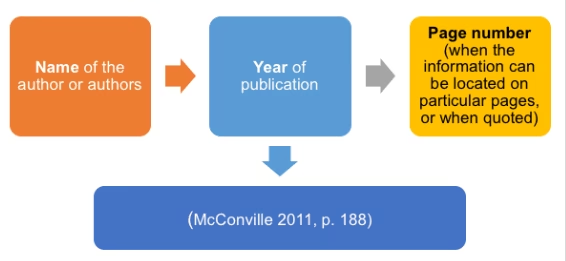
Include three pieces of information about a source within the text of your work:
- the name of the author or authors
- the year of publication
- the page number (when the information/idea can be located on a particular page or when directly quoted).
Examples of in-text citation for direct quotations
Bendell and Kleanthous (2007:2) assert that luxury brands “have both the opportunity and the responsibility to promote sustainable consumption”
As Bendell and Kleanthous argue, “most of the writing at university is likely to involve presenting a position” (2007: 2).
Step 3: Reference list
- A list to refer to more information of the sources in the paper
E.g. Name of the website, the date you look at it
Sample Harvard style Reference list
- Brown, T. (1998). Genetics: a molecular approach. 3rd ed. London: Chapman and Hall.
- Fontana-Gusti, G. (2008). Designing Cities for People: Social, Environmental and Psychological Sustainability. London: Earthscan.
- Sadler, P. (2003). Strategic Management [Online]. Sterling: Kogan Page. Available from: http://www.netlibrary.com/reader/. [Accessed 20 Aug 2003].
HARVARD REFERENCING
- In-text citation: briefly indicate the source within your writing immediately after using the source
- Reference list: a complete list of all the cited references used in your writing
In-text citation
Bendell and Kleanthous (2007:2) assert that luxury brands “have both the opportunity and the responsibility to promote sustainable consumption”. In their extensive report for the WWF and in a similar report written by DeBeers (2009), there is the assumption that trends in ethical consumption will naturally transition into creating markets for ethical-luxury goods. However, we know from extensive work in the consumer behaviour field that consumers are looking for a distinctly different set of benefits when buying luxury products compared to their commodity purchases (Nia and Zaichhkowsky 2000; Vigneron and Johnson 2004; Ward and Chiari 2008).
- Brown (1998) argues that…
- … (Brown, 1998).
- “…” (Brown, 1998:87).
- Pressey and Epp (2002) argue that…
- … (Pressey and Epp, 2002).
- “…” (Pressey and Epp, 2002:212).
Reference list
- Each list item requires specific information.
- List each item in alphabetical order, by author surname.
- Titles should be in italics.
- Each item should have a hanging indent.
Books with 1 author
- Surname, Initials (Publication year). Book title and subtitle. Edition. Place of publication: Publisher.
- Example:
- Brown, T. (1998). Genetics: a molecular approach. 3rd ed. London: Chapman and Hall.
Books with 2 or more authors
- Surname, Initials, Surname, Initials and Surname, Initials (Publication year). Book title and subtitle. Edition. Place of publication: Publisher.
- Example:
- Wallace, R. A. and Wolf, A., (2006). Contemporary sociological theory: expanding the classical tradition. 6th ed. Upper Saddle River, N.J.: Prentice Hall.
Journal Article
- Surname, Initials (Year of publication). Title of article. Title of journal in Italics. Volume number (issue number), page numbers.
- Example:
- Pressey, A.W. and Epp, D. (2002). Spatial attention in penzo-like patterns. Perception and psychophysics, 50 (2), 211-221.
Website
- Author, Initials or Corporate Author (Publication year). Title [Online]. Available from: URL [Accessed Day Month year].
- Example:
- Coxhead, P. (2000). A referencing style guide [Online]. Available from: http://www.csbham.ac.uk/~pxc/refs/ [Accessed 2 November 2013].
Review Lesson – Provide reference for the provided sources
- https://siteman.wustl.edu/wp-content/uploads/2017/08/98366_Prevention.pdf
- https://aifs.gov.au/cfca/publications/changing-role-grandparents
- https://www.worldcat.org/title/academic-writing-from-paragraph-to-essay/oclc/1058065241?referer=di&ht=edition
Answers:
- Journal Article
changing-role-grandparents_79Ngsy https://aifs.gov.au/cfca/publications/changing-role-grandparents
Journal Article
Surname, Initials (Year of publication). Title of article. Title of journal in Italics. Volume number (issue number), page numbers.
Example:
Pressey, A.W. and Epp, D. (2002). Spatial attention in penzo-like patterns. Perception and psychophysics, 50 (2), 211-221.
🡪 Ochiltree, G. (2006). The changing role of grandparents. Australian Institute of Family Studies, (2), 1-9.
Website
Author, Initials or Corporate Author (Publication year). Title [Online]. Available from: URL [Accessed Day Month year].
Example:
Coxhead, P. (2000). A referencing style guide [Online]. Available from: http://www.csbham.ac.uk/~pxc/refs/ [Accessed 2 November 2013].
🡪 Washington University School of Medicine. (2017). 8ight ways to stay healthy and prevent cancer [Online]. Available from: https://siteman.wustl.edu/wp- content/uploads/2017/08/98366_Prevention.pdf [Accessed 19 May 2020].
Book
- Academic Writing _CoS2cj https://www.worldcat.org/title/academic-writing-from-paragraph-to-essay/oclc/1058065241?referer=di&ht=edition
Books with 1 author
Surname, Initials. (Publication year). Book title and subtitle. Edition. Place of publication: Publisher.
Example:
Brown, T. (1998). Genetics: a molecular approach. 3rd ed. London: Chapman and Hall.
Books with 2 or more authors
Surname, Initials, Surname, Initials and Surname, Initials. (Publication year). Book title and subtitle. Edition. Place of publication: Publisher.
Example:
Wallace, R. A. and Wolf, A. (2006). Contemporary sociological theory: expanding the classical tradition. 6th ed. Upper Saddle River, N.J.: Prentice Hall.
🡪 Zemach, D. E. and Rumisek, L. A. (2005). Academic writing: from paragraph to essay. 2nd ed. Oxford, U.K.: Macmillan Education.
References:
Bauer-Ramazani, C. (2021). Paraphrasing and summarising [PowerPoint slides]. Saint Michael’s College.
https://academics.smcvt.edu/cbauer-ramazani/cbr/default.htm
Deakin University. (2024). Summarising, paraphrasing, quoting and referencing. https://www.deakin.edu.au/__data/assets/pdf_file/0011/31151/Deakin-guide-to-APA7.pdf
Monash University Library. (2012). Paraphrasing, summarising and quoting (referencing guide).
https://guides.lib.monash.edu/ld.php?content_id=8481587
Newcastle University Library. (2026). Referencing quiz.
https://www.ncl.ac.uk/academic-skills-kit/good-academic-practice/referencing/how-to-reference/referencing-quizzes/
UNSW Sydney. (2026). Harvard referencing.
https://student.unsw.edu.au/harvard-referencing
University of Sheffield Library. (2026). Referencing (Harvard). https://www.librarydevelopment.group.shef.ac.uk/referencing/harvard.html
Vietnam – UK Institute for Research and Executive Education, the University of Danang. (2019). Regulations on Academic Integrity of the Vietnam – UK Institute for Research and Executive Education, the University of Danang. https://drive.google.com/file/d/1X_B8fsE0lTnJVpzrgXHmeFf5t-cI5vFa/view
Author contact information:
Trang Thi Minh Le, MA
trang.le@vnuk.edu.vn Lecturer of English, Department of Language Studies and International Foundation Programmes
VNUK Institute for Research and Executive Education, The University of Danang
158A Le Loi Street, Hai Chau District, Danang City