In university, note-taking is not simply the act of writing down what your lecturer says—it’s an intellectual process of selecting, organizing, and consolidating information. Effective note-taking helps you understand, remember, and critically engage with what you learn in class and through readings.

Why Note-taking Matters
Taking notes helps you:
- Capture and organize key ideas.
- Engage actively with content during lectures and readings.
- Improve memory through the act of summarizing.
- Build connections between different topics and disciplines.
- Prepare efficiently for exams, essays, and presentations.
Research shows that students who write notes in their own words retain more and think more critically. When you write, you must interpret, prioritize, and reformulate information—skills at the heart of academic success.
Common Difficulties in Note-taking
Even experienced students face challenges:
- Trying to copy everything the lecturer says.
- Getting lost when the pace is too fast.
- Producing notes that are messy or unclear.
- Not knowing what information is relevant.
- Forgetting to review notes after class.
The good news? These challenges fade with technique, reflection, and regular practice.
Effective Note-taking Methods
Let’s look at five proven techniques. Each suits different contexts—try them all and see what fits best with your subjects and learning style.
- The Cornell Method
Divide your page into three parts: a Notes column, a Cue column, and a Summary section.
During class, write main ideas in the Notes column. After class, add guiding questions in the Cue column and a brief summary below.
Example:
- The Outline Method
Use headings, subheadings, and bullet points to show logical relationships between ideas.
Example:
- Stages of Cultural Adaptation
- Honeymoon phase – excitement, curiosity
- Crisis phase – frustration, confusion
- Adjustment – increased comfort and confidence
Clear, structured, and perfect for lectures that follow a logical progression.
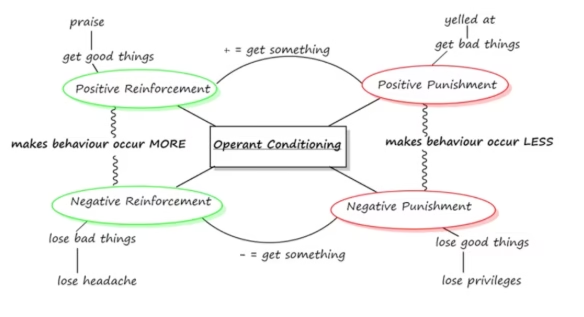
- The Mapping Method
A visual approach using a central concept with branches that represent related ideas. Great for brainstorming or subjects that emphasize relationships—like sociology or biology.
Example:
- The Charting Method
Place information into columns to compare features.
| Theory | Founder | Key Contribution | Limitation |
|---|---|---|---|
| Constructivism | Piaget | Learning as active knowledge construction | Less focus on social factors |
Excellent for comparing models or theorists.
- The Sentence Method
Write down main ideas as short, separate lines.
Example:
- Classical conditioning pairs a neutral stimulus with a response.
- Operant conditioning strengthens behavior through reinforcement.
Useful for fast lectures or when outlines aren’t possible
Essential Tips for Effective Note-Taking
To make your notes truly effective, focus on quality over quantity. Here are some proven tips:
- Prepare in Advance: Skim readings or lecture outlines before class. This primes your brain to identify key points. For example, if you’re attending a psychology lecture on Freud, review basic theories so you can note nuances rather than basics.
- Listen Actively: In lectures, focus on the speaker’s emphasis—repeated phrases, examples, or transitions like ” importantly” signal key ideas. Avoid transcribing everything; aim to paraphrase in your own words to enhance comprehension.
- Use Abbreviations and Symbols: Develop a shorthand system, like “w/” for “with,” “→” for “leads to,” or “e.g.” for examples. This saves time and keeps you engaged.
- Organize Visually: Use colors, underlining, or boxes to highlight main ideas, definitions, and questions. Digital tools like Notion or OneNote allow searchable tags, while paper notes benefit from spatial memory.
- Review and Revise Promptly: Within 24 hours, review your notes to fill gaps and summarize. This leverages the spacing effect, where revisiting material strengthens memory.
- Integrate Multimedia: For visual learners, sketch diagrams or add links to videos. In digital notes, embed images or audio clips from lectures.
- Adapt to the Medium: Handwritten notes promote better retention for conceptual subjects, but typing is faster for voluminous content. Hybrid approaches, like typing then handwriting summaries, combine strengths.
- Seek Feedback: Share notes with peers or tutors to identify blind spots. Over time, this refines your technique.
- Practice Regularly: Like any skill, note-taking improves with deliberate practice. Start small—note a podcast episode—and build up.
Wrapping Up
Mastering academic note-taking is a game-changer for your studies. By understanding the basics, applying tips, and experimenting with methods through examples, you’ll create notes that not only capture information but also enhance learning. Consistency is key—refine your approach over time, and watch your academic performance soar. Remember, great notes aren’t about perfection; they’re about what works for you. 
Quick Quiz: Test Your Note-taking Knowledge
- What is the main purpose of note-taking during university lectures?
a) To write down everything the lecturer says
b) To record key ideas for later review and understanding
c) To impress the lecturer with neat handwriting
d) To avoid paying attention during class - Which note-taking method divides the page into Cue, Notes, and Summary sections?
a) Outline Method
b) Cornell Method
c) Mapping Method
d) Charting Method - When should you review your lecture notes for best retention?
a) The night before the exam
b) Within 24 hours after class
c) One week later
d) Never – just trust your memory - In the Cornell Method, what goes in the left “Cue” column?
a) Full lecture notes
b) Questions or keywords for self-testing
c) Diagrams and drawings
d) The lecturer’s contact information - Which method is best for showing relationships between ideas visually?
a) Sentence Method
b) Mapping Method
c) Charting Method
d) Outline Method - What should you do BEFORE a lecture to improve note-taking?
a) Review slides or chapter headings
b) Sleep in to stay fresh
c) Skip the lecture and read later
d) Text friends about weekend plans - Which is a good abbreviation to use during fast lectures?
a) “etc.” for “and so on”
b) “→” for “leads to”
c) “LOL” for “lots of learning”
d) All of the above - The Charting Method works best when you need to:
a) Compare different theories or categories
b) Draw mind maps
c) Write long paragraphs
d) Record fast speech without structure - Why is handwriting notes better than just typing for memory?
a) It’s neater
b) It forces you to process and summarize information
c) Laptops are expensive
d) Professors prefer paper - After taking notes, what should you add to make them more useful?
a) Food stains for personality
b) Questions, highlights, and a summary
c) Your friend’s phone number
d) Nothing – they’re perfect already
Answer Key:
- b – To record key ideas for later review and understanding
- b – Cornell Method
- b – Within 24 hours after class
- b – Questions or keywords for self-testing
- b – Mapping Method
- a – Review slides or chapter headings
- b – “→” for “leads to” (a is also good, but b shows active shorthand)
- a – Compare different theories or categories
- b – It forces you to process and summarize information
- b – Questions, highlights, and a summary
Practice Exercise
Read the short academic-style passage below carefully. Then, using one of the note-taking methods to create a brief set of notes in your own notebook.
Sample Passage:
The Impact of Sleep on Academic Performance
Sleep plays a vital role in students’ learning, memory, and overall cognitive function. Research shows that lack of sleep can severely affect attention, concentration, and problem-solving abilities—all of which are essential for academic success. During sleep, the brain consolidates information gathered throughout the day, transferring it from short-term to long-term memory. Consistent sleep deprivation not only leads to fatigue but also weakens immune function and emotional regulation.
Many university students underestimate the importance of proper rest due to heavy workloads and late-night study habits. However, quality sleep—between 7 to 9 hours per night—is as critical as studying itself. Establishing a regular sleep schedule, limiting screen time before bed, and maintaining good sleep hygiene can significantly improve academic outcomes, emotional stability, and overall well-being.
Your Task:
- Choose one note-taking method from the lesson (Cornell, Outline, Mapping, or Charting).
- Create notes that:
- Capture key ideas, supporting evidence, and causes/effects.
- Use abbreviations, symbols, or visual structure to show relationships.
- Stay concise — no full sentences.
- After finishing, review your notes and ask:
- What is the main argument of the passage?
- What are three supporting details or examples?
- What practical advice is mentioned?
SAMPLE ANSWER:
This is a note following outline method:
- Role of sleep
- Supports learning, memory, cognition
- Consolidates info (short → long-term)
- Effects of lack of sleep
- ↓ attention, concentration, problem-solving
- Fatigue, weak immunity, emotional issues
III. Student habits + solutions
- Late-night study, underestimate sleep
- 7–9 hrs; regular schedule; ↓ screen; good sleep hygiene
References:
Cornell University Learning Strategies Center. (2020). The Cornell note taking system.
https://lsc.cornell.edu/how-to-study/taking-notes/cornell-note-taking-system/
Coursera. (2025). 7 effective note-taking methods.
https://www.coursera.org/articles/note-taking-methods
Harvard University Academic Resource Center. (2023). Note-taking.
https://academicresourcecenter.harvard.edu/2023/10/02/note-taking/
Mueller, P. A., & Oppenheimer, D. M. (2014). The pen is mightier than the keyboard: Advantages of longhand over laptop note taking. Psychological Science, 25(6), 1159–1168. (Referenced in multiple sources like )
Oxford Learning. (2025). How to take study notes: 5 effective note taking methods.
https://oxfordlearning.com/5-effective-note-taking-methods/
University of Tennessee at Chattanooga. (2024). Common note-taking methods.
University of Newcastle Academic Skills Kit. (2022). Note-taking strategies.
University of York Library. (2024). Note-taking: A practical guide.
https://subjectguides.york.ac.uk/note-taking